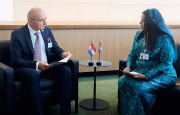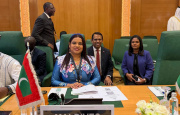



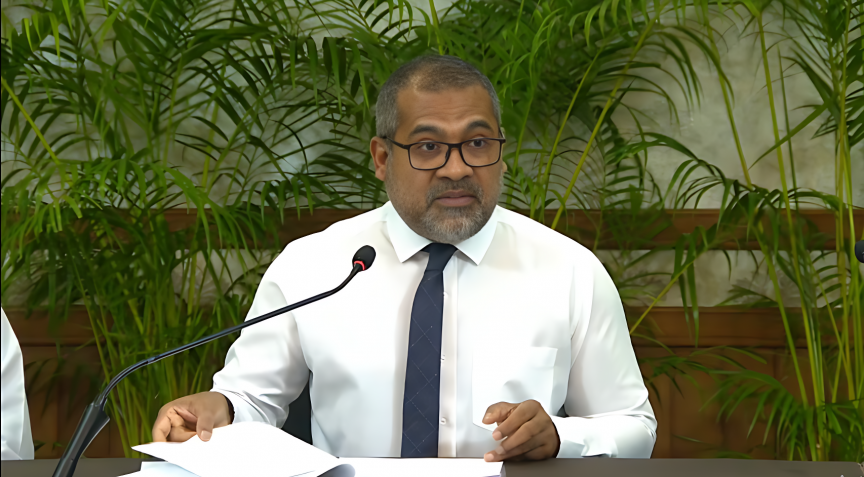
Foreign Minister Dr. Abdulla Khaleel speaks at a press conference at the President’s Office, where a special Cabinet committee briefed the media on national issues arising from the Middle East conflict, March 12, 2026. (Photo/President's Office)
Foreign Minister Dr. Abdulla Khaleel says the Maldives has rejected requests to use its airspace for purposes related to the ongoing Middle East conflict, and will not permit such use under any circumstances.
Speaking at a press briefing held by the President’s Special Ministerial Committee on Thursday, Khaleel said the government has been receiving requests concerning Maldivian airspace. He stressed that none of these requests have been approved.
“Maldivian airspace has never been used to attack any country. Please note that we are also rejecting such incoming requests,” Khaleel said.
He said the government’s top priority is safeguarding the country’s security and economic stability. Khaleel added that the government is also working to assist Maldivians living in conflict‑affected areas, some of whom have already relocated to safer regions.
The minister noted that the conflict has had significant global repercussions. Iran closed the Strait of Hormuz on February 28 in response to Israeli and US attacks, a chokepoint that carries one‑fifth of the world’s oil. Several Middle Eastern producers have also reduced output, contributing to rising fuel prices in Maldives.
Economists warn that spikes in oil prices typically push up food prices due to higher transport costs, and that major oil shocks have historically been followed by global economic slowdowns.