


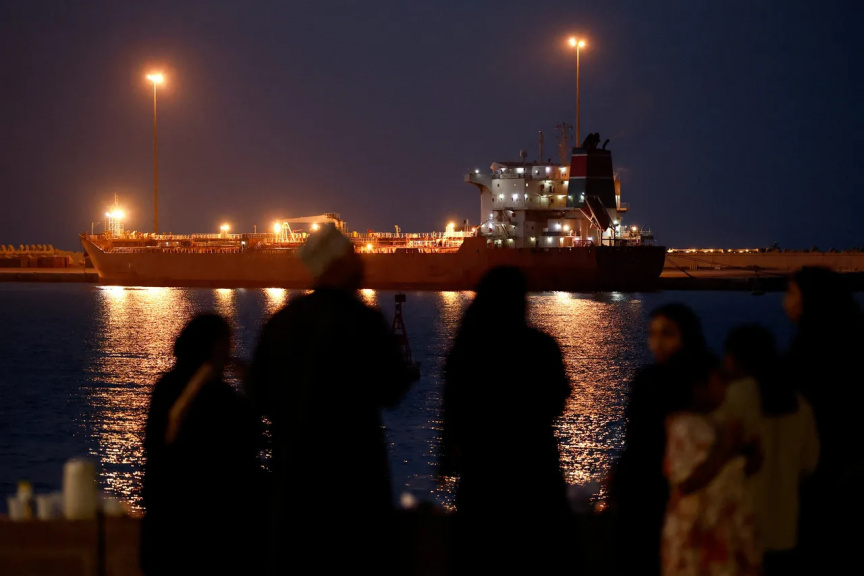
The Callisto tanker sits anchored in Port Sultan Qaboos as the traffic is down in the Strait of Hormuz, in Muscat, Oman, on March 12, 2026. (Photo/Reuters)
Only 77 ships have so far crossed the Strait of Hormuz in March as the Middle East war disrupts one of the world's most vital shipping routes, a maritime data firm has reported.
Lloyd's List Intelligence said on Friday most of these vessels belonged to the so-called "shadow fleet" — ships used to skirt Western sanctions and regulations, typically linked to Russia and Iran.
They are often ageing ships in poor condition, without proper insurance and with opaque ownership.
The 77 transits recorded so far this month compare with 1,229 passages between March 1 and 11 last year, according to Lloyd's List Intelligence.
Iran's Revolutionary Guards have all but closed the Strait of Hormuz, which borders Iran and through which 20 percent of global oil supplies pass.
Rising attacks on vessels
Since the start of March, 20 commercial vessels, including nine oil tankers, have been attacked or reported incidents, according to the UK Maritime Trade Operations agency.
Meanwhile, the International Maritime Organization has confirmed 16 incidents in the area, including eight involving oil tankers.
Iran's new supreme leader Mojtaba Khamenei said on Thursday that "the lever of blocking the Strait of Hormuz must definitely be used."
The strategy is aimed at harming the global economy in order to exert pressure on the United States.
Iran, Greece and China lead limited Hormuz traffic
"Over half of the tankers and gas carriers going through are shadow fleets," said Bridget Diakun, a senior analyst at Lloyd's List Intelligence.
"These ships are really used to disruptions," so are more likely to attempt the passage, she added.
According to the firm, vessels affiliated with Iran account for 26 percent of passages through Hormuz, followed by Greece with 13 percent and China with 12 percent.
"The main takeaway here is that... Iran is still exporting," Diakun said.
Separately, AFP counted around 40 vessels that have crossed the Strait of Hormuz since the start of the conflict, considering only those that kept their AIS transponder — the automatic identification system — switched on.
___
Source: TRT