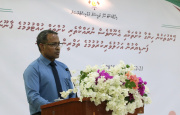



Ali Hussain speaks to reporters on February 26, 2025. (Sun Photo/Naaish Nahid)
The Supreme Court has rejected the constitutional case lodged by attorney-at-law and former Kendhoo MP Ali Hussain asking the court to overturn the constitutional amendment on synchronizing the presidential and parliamentary elections.
Under the current system, voters go to polls twice within around six months every five years, electing the president in September and members of Parliament in April.
On February 10, the ruling People’s National Congress (PNC) used its supermajority in the Parliament to pass constitutional amendments proposed by the government to hold future presidential elections and parliamentary elections on the same day.
These constitutional amendments propose merging the two elections, and bringing forward the start of the parliamentary term from May to December 1 to get this done.
This change will shorten the five-year term of the current parliamentary assembly, sworn in on May 28, 2024, by around six months.
The first combined poll would take place in 2028.
On February 16, President Dr. Mohamed Muizzu decreed that a public referendum on this – as required by law on such matters – would be held on April 4 – the same day as the local council elections.
The Supreme Court received two constitutional cases last week, challenging the referendum.

One of the cases was lodged by Ali Hussain asking the court to overturn the bill arguing the 15-day window for ratification of the constitutional amendments has already expired, and the other was filed by attorneys Ibrahim Shiyam and Aik Ahmed Easa arguing that the question proposed in the presidential decree calling for the referendum is unconstitutional.
While latter was accepted by the Supreme Court, with hearings set to start Thursday, Ali Hussain’s case was rejected on Wednesday.
In his petition, Ali Hussain asked the court to declare the bill void as the 15-day window established by the Constitution for ratification of the bill has lapsed, and to also declare the upcoming referendum on the bill illegal.
However, the court’s registrar Rauf Haidar rejected the case, citing that Article 264 of the Constitutional only pertains to situations where the President does not assent to a bill. He decided that there’s nothing in the documents submitted by Ali Hussain showing the President has decided not to ratify the bill.
In a post on X on Wednesday afternoon, Ali Hussain criticized the decision by stating that “it is wrong to pass a judgement without a hearing. The Supreme Court’s registrar is not a judge.”
އަޑުއެހުމެއް ނެތި ނިޔާ ކަނޑައެޅުން ގޯސް. ސުޕްރީމް ކޯޓުގެ ރެޖިސްޓްރާ އަކީ ފަނޑިޔާރެއް ނޫން. pic.twitter.com/VODCcFGjty
— Ali Hussain (@AleeVoice) March 25, 2026
While the court rejected Ali Hussain’s case, it greenlighted the one lodged by Shiyam and Aik, who argue that the question in the decree fails to meet legal criteria set in the Constitution, and asks the court to halt the referendum.
President Muizzu decreed for the following question to be asked of the public:
“Do you approve the ratification of the Eighth Amendment to the Constitution, which provides for the Presidential and People’s Majlis elections to be held concurrently and for a change to the term of the People’s Majlis?”
But Shiyam and Aik argue that the people should instead be asked whether they consent to making the constitutional amendment in the first place.
While the petition questions the legality of the question, the Attorney General’s Office issued a statement last week insisting that it meets all requirements stipulated by the Constitution.
The main opposition Maldivian Democratic Party (MDP) has also filed a separate case with the Civil Court seeking to halt the referendum. The party said on Friday that the case has been rejected thrice, and urged the court to register it as soon as possible.