



Boredom usually gets a bad rap, which is quite beyond my understanding—to put it simply. I fail to view how being bored could possibly be a bad thing. After all, it’s become somewhat rare to find these days. There was a time when boredom was simply part of everyday life.
People sat on harbor walls watching boats come and go. They waited for ferries between islands with nothing but the sea and their thoughts for company. Children spent long afternoons wandering neighborhoods, playing outside, or complaining that there was nothing to do. Evenings were often spent talking with family, neighbors, and friends.
I admit I was born into the age of rising technology, but even still, I wasn’t exposed to a lot of media until I’d grown a little bit older. I didn’t have cable TV at home for the longest time, nor did I have WiFi. My sisters and I were left to entertain ourselves on our own. We often conjured scenarios in our little heads, played out those made-up stories, and acted out the roles. Our combined and individual imaginations were extraordinary. I’d go as far as to even say I might have been at my most creative back then.
Today, many of those moments have almost disappeared.
The instant we encounter even a few seconds of downtime, we reach for our phones. Waiting for a ferry or a bus in Male’ becomes an opportunity to check TikTok. A quiet moment at home turns into another hour of scrolling through Instagram or watching YouTube videos. Every empty space in our day is quickly filled with messages, news updates, reels, podcasts, and endless streams of content.
We often celebrate this as progress (I am guilty of doing the same). Why be bored when entertainment is available at the tap of a screen? And don’t get me wrong—I do believe that adapting to technology, consuming media, and keeping ourselves entertained have their perks. It’s how we stay connected and informed. It’s how we stay vigilant. I believe I’m not wrong in saying that it also helps develop many fundamental and necessary skills such as critical thinking.
But what if boredom was never a problem?
What if, in our determination to eliminate boredom, we have also eliminated something quite essential?
The war on boredom

Modern media platforms are designed to capture and hold our attention. Social media feeds never truly end. Streaming services automatically play the next episode. Short-form video platforms continuously serve content tailored to our interests.
The goal is simple: keep us engaged—or distracted(?)
This is not merely an observation. Scholars in media studies and behavioral psychology have argued that many digital platforms are built around what is often called the “Attention Economy.” Former Google design ethicist Tristan Harris and researchers studying persuasive technology have shown how features such as infinite scrolling, autoplay, push notifications, and algorithmic recommendations are intentionally designed to maximize user engagement and time spent on platforms.
Note: The “Attention Economy” refers to the marketing and branding strategies companies use to capture your attention in an effort to maintain profitability (Coursera, 2025).
In the Maldives, where smartphone penetration is high and internet access has become widespread, this shift has happened remarkably quickly. Whether on a speedboat, in a café in Male’, or relaxing on an island or a resort, many of us now carry an endless source of entertainment in our pockets. In this time, age, and environment, boredom has become an enemy to defeat or eradicate. The moment we feel unstimulated, technology offers an immediate escape. We no longer need to sit with discomfort, uncertainty, or inactivity. There is always something to watch, read, like, share, or consume.
It’s always much easier to run away from our feelings and thoughts than actually confront them, isn’t it? Technology has enabled us to flee—so many among us have gotten used to suppressing their emotions and bottling things up. They’d rather stay distracted than feel any sort of discomfort. And boredom—having nothing to do—opens up an opportunity and provides the necessary space and quiet needed to reach those unresolved feelings.
The shift from how things used to be before technology becoming the norm has transformed the way we experience everyday life. Waiting no longer feels like waiting. Commuting no longer feels like commuting. Even brief moments of silence have become opportunities for consumption.
Yet, the disappearance of boredom may have consequences that extend beyond how we spend our time.
Why boredom matters

Like I said in the beginning of this article, boredom has an undeservedly bad reputation. Most people think of it as a negative state—a feeling of restlessness, frustration, or dissatisfaction. However, psychologists increasingly argue that boredom serves an important purpose.
It acts as a signal. Boredom tells us that our current activity is not meaningful or engaging enough. It encourages us to seek new experiences, explore ideas, and pursue goals.
Psychologist John Eastwood and colleagues in a widely cited paper published in “Perspectives on Psychological Science (2012)”, describe boredom as a state in which people want to engage with the world but are unable to find a satisfying activity. Rather than being meaningless, boredom functions as a motivational signal that pushes people to seek purpose, challenge, or novelty.
More importantly, boredom creates the conditions for something many of us rarely experience anymore: mental wandering.
When we aren’t focused one external simulation, our minds often drift. We reflect on conversations, revisit memories, imagine future possibilities, and connect ideas in unexpected ways. Research suggests that these periods of mind-wandering can contribute to creativity, problem-solving, and long-term planning. The wandering mind is not necessarily an unproductive mind. In many cases, it is doing some of its most important work.
Neuroscientists have linked mind-wandering to activity in what is known as the brain’s “default mode network”. Research by Marcus Rachle and colleagues found that this network becomes active when people are not focused on external tasks. Studies suggest that during these periods, the brain engages in self-reflection, memory consolidation, future planning, and creative thinking.
The death of daydreaming

As a writer, I can confidently say that almost every one of my ideas arrive unexpectedly. A solution to a problem could appear during a walk along the beach. A creative idea could emerge while watching the waves. A difficult decision becomes clearer during a quiet bus ride from Male’ to Hulhumale’ (if I don’t have my headphones on me—guilty as charged!)
These moments occur because the mind is given space to roam.
For generations, we experienced countless periods of unstructured thinking. Several moments of peace and quiet provided bright opportunities for reflection. Daydreaming was not viewed as a productivity tool, but it was often a natural consequence of having time with one’s thoughts.
Today, those opportunities are increasingly rare.
Whenever our attention begins to drift, a device is waiting to redirect it. The phone in our pocket has become a constant companion, ensuring that solitude is never truly solitary and silence is rarely silent. As a result, many of us spend more time-consuming other people’s thoughts than exploring our own.
A well-known study by psychologists Benjamin Baird, Jonathan Schooler, and colleagues, published in “Psychological Science (2012)”, found that participants performed better on creative problem-solving tasks after engaging in activities that allowed their minds to wander. The researchers concluded that mind-wandering can support what is known as “incubation”; which is a process that helps generate creative insights.
Have we lost the space to think?

The issue is not that technology is harmful. As I mentioned earlier, smartphones, social media, and digital platforms have brought undeniable benefits to all of us. They offer connection, provide access to education and information, support businesses, and offer entertainment on demand.
The concern is what happens when consumption leaves no room for reflection.
Forgive me if I’m repeating similar things that were previously explored and allow me to do so out of importance. Experiences often require time to be processed and understood. Emotions need space to regulate and settle. Ideas need time to develop. If every uncomfortable feeling is immediately distracted away, when do we process it? If every spare moment is occupied by content, when do we reflect on our lives?
If every silence is interrupted, when do we hear our own thoughts?
These questions are increasingly relevant in a culture driven by constant stimulation. We have become extraordinarily skilled at filling empty moments, but perhaps less skilled at using them.
Psychologists have also found links between digital multitasking and reduced attentional control. Research by Eyal Ophir, Clifford Nass, and Anthony Wagner at Stanford University suggested that heavy media multitaskers often struggle more with filtering distractions and maintaining focus compared to lighter media users.
The paradox of infinite entertainment

One of the great ironies of the digital age is that more entertainment does not necessarily mean greater satisfaction. We live in a world where millions of videos, songs, articles, and games are available at any moment. Yet, many people report feeling restless, distracted, and chronically disengaged.
The problem may not be a lack of simulation but an excess of it.
Constantly switching between pieces of content can fragment our attention. Rather than becoming deeply engaged, we remain in a state of perpetual distraction. We move from one video to another, one post to the next, chasing novelty without ever feeling fully satisfied.
Social psychologist Gloria Mark, whose work focuses on attention in digital environments, has found that frequent interruptions and task-switching can increase cognitive load and make it harder for people to sustain concentration. Her research suggests that constantly shifting attention may leave people feeling mentally fatigued even when they are not engaged in demanding work.
In our quest to avoid boredom, we may be creating a different kind of emptiness—one filled with activity but lacking reflection.
This is particularly striking in a country surrounded by natural beauty. We can sit beside the ocean, watch a sunset over the lagoon, or travel across open water, yet still find ourselves focused on a screen.
Creativity needs empty space

Creativity rarely emerges from constant consumption. Artists, writers, entrepreneurs, and thinkers have long recognized the value of quiet moments (Exhibit A: Yours Truly). Many creative breakthroughs occur not while actively working but during periods of rest, wandering, and reflection.
This is because creativity often depends on making unexpected connections between ideas. Those connections are more likely to occur when the mind is free from immediate demands and distractions.
Boredom creates that freedom.
It provides the mental space necessary for curiosity to develop, for questions to emerge, and for imagination to flourish.
Personal note: I’ve written majority of my poems sitting at the beach, watching the golden rays of the sun dance on the surface of the ocean as the sun itself slowly rose in the early hours of the morning; easily the best feeling of my life.
In a study published in “Academy of Management Discoveries (2018)”, researchers Sandi Mann and Rebekah Cadman found evidence that boredom can encourage creative thinking by motivating individuals to seek new ideas and alternative ways of engaging with their environment. Their findings challenge the assumption that boredom is always negative.
A society that eliminates boredom entirely may also be reducing opportunities for creativity—not because people lack talent—but because they lack the uninterrupted mental space in which creativity often begins.
For a young and rapidly changing nation like the Maldives, protecting that space may be more important than ever.
Bringing back empty moments

The solution is not to abandon technology (like that’s possible in this day and age) or romanticize the past. Few people genuinely want to return to an era of limited connectivity and fewer opportunities. Digital media has enriched our lives in countless ways.
But perhaps there is value in reclaiming some of the empty moments we have lost.
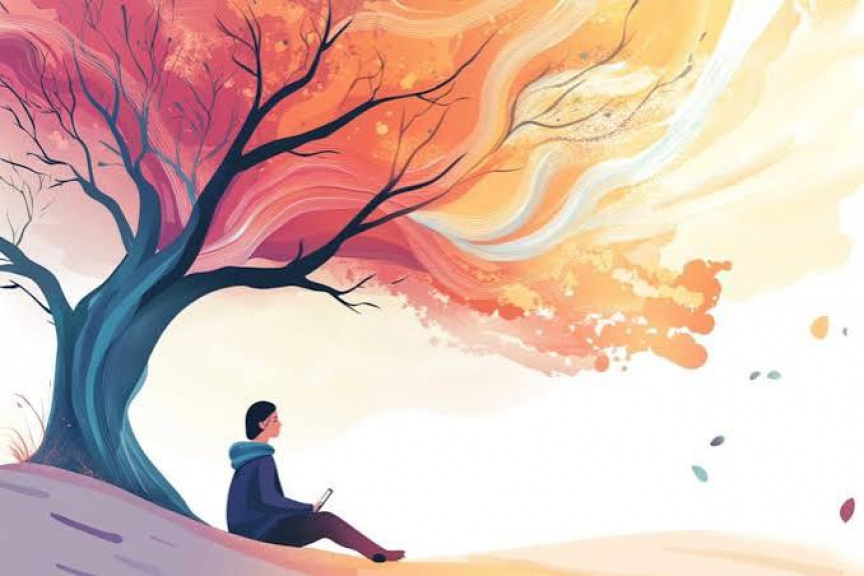
Not every bus ride needs to be filled with scrolling. Not every sunset requires a photo or video. Not every spare minute must be optimized, entertained, or occupied. Sometimes it’s enough to sit quietly, watch the ocean, and let the mind wander.
A growing body of psychological and neuroscience research suggests that periods of rest, reflection, and mind-wandering are not wasted time. Rather, they play an important role in memory, creativity, emotional processing, and self-understanding—functions that are difficult to cultivate when attention is constantly occupied.
In our effort to eliminate boredom, we may have accidentally eliminated some of the conditions that make us thoughtful, imaginative, and fully human. That is something worth pondering about—don’t you think?
Check out the research papers/articles I referenced via the following links: