


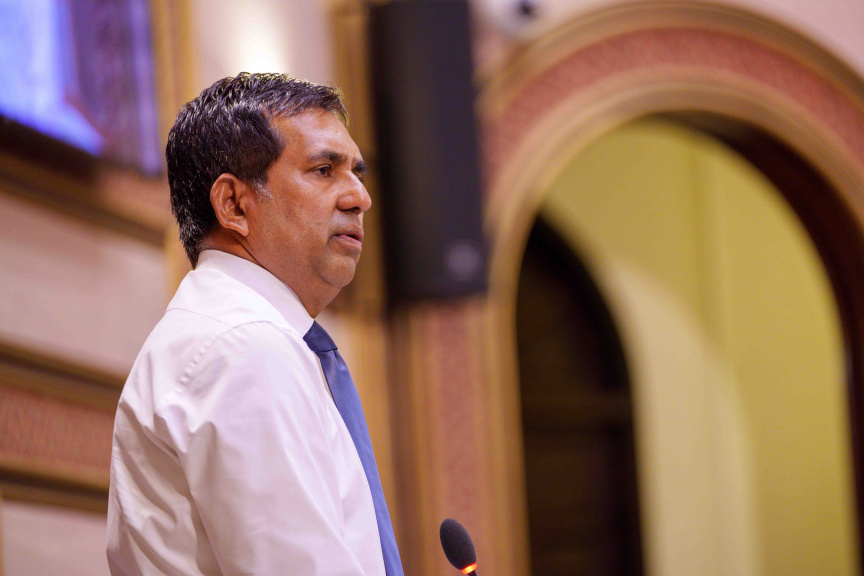
Economic Minister Mohamed Saeed responds to questions at the Parliament on July 6, 2026. (Photo/People's Majlis)
Economic Minister Mohamed Saeed continues to assert that the US dollar crisis facing the Maldives is the result of policies adopted by the past two Maldivian Democratic Party (MDP) administrations.
President Dr. Mohamed Muizzu had pledged to resolve the USD crisis and bring an end to the dollar black market when he took office in 2023. However, the issue continues to persist, nearly three years into office, with the exchange rate above MVR 20 in the black market.
Saeed, who was summoned to the Parliament on Monday morning, was questioned regarding the high exchange rate by Vaikaradhoo MP Hussain Ziyad (Fittey), a lawmaker from the MDP.
Saeed said the exchange rate rose because of decisions made by past MDP administration: President Ibrahim Mohamed Solih’s administration’s decision to print over MVR 8 billion amid the economic downturn during the Covid-19 pandemic and President Mohamed Nasheed’s administration’s decision to introduce a 20 percent fluctuation band, allowing the official exchange rate to fluctuate within a band of MVR 10.28 and MVR 15.42.

He said that the Maldivian people continue to experience the adverse effects of these decisions.
Saeed said that it was an MDP-controlled Parliament that approved the suspension of clauses in the Fiscal Responsibility Act in order to enable Solih’s administration to print money.
“We warned even back then that we would all face the consequences of that decision,” said Saeed, who had been serving as the parliamentary representative for the Maavah constituency at the time.
Saeed said that President Muizzu’s focus was on clearing the country’s staggering debt and building a strong and reliable economy.
The country’s foreign exchange woes have been linked to a rise in inflation, with sharp rises in price of food and other necessities.