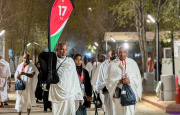




Islamic Minister Dr. Mohamed Shaheem Ali Saeed speaks to reporters on October 12, 2026. (Photo/Islamic Ministry)
Islamic Minister Dr. Mohamed Shaheem Ali Saeed said on Monday that relevant authorities have not issued any official warning of any danger to Maldivian pilgrims due to the ongoing Houthi attacks on Saudi Arabia, including its airports.
Saudi Arabia has faced five attacks on its airports in less than a week, including attacks on the King Khalid International Airport near Saudi capital, Riyadh, which killed 13 people on Saturday and one more again on Sunday.
Shaheem and Maldives Hajj Corporation’s Managing Director Mohamed Firzul Abdulla Khaleel, who held a press briefing on Monday afternoon, where questioned by reporters regarding what the attacks mean for the upcoming October umrah pilgrimage.
Shaheem responded that the Maldivian government makes its decisions on sending pilgrims to Mecca based on statements issued by Saudi authorities, and that he has not come across any such statement by the Saudis warning of any danger to umrah pilgrims.
“Every harm to Saudi Arabia is deeply saddening for all Muslims, especially the Maldives. We always wish for and hope for, for Almighty Allah to grant peace and safety to the Saudi Arabian government, the beloved people of Saudi Arabia, the Two Holy Harams,” he said.

He asked Maldivians to continue to pray for the safety of the Two Holy Harams.
Shaheem said that Saudi Arabia is a crucial destination for Maldivians, especially pilgrims.
“In Sha Allah, no official authority has warned of any danger to our pilgrims. I therefore believe there’s no such concern at this time,” he said.
Firzul told reporters that there currently weren’t any Maldivian pilgrims in Saudi Arabia.
He added that Maldivian umrah pilgrims have always taken the Jeddah route, instead of the Riyadh route.
Firzul said that the Hajj Corporation has always followed the government instructions, and has not received any special instructions in light of the current circumstances.

The attack on the Riyadh airport on Sunday marked the fourth assault on the international airport in a week. The attack a Pakistani resident and injured 11 others. Meanwhile, an attack on the same airport the previous day killed 13 people, including at least four Saudi citizens and two Bangladeshis, along with one person each from the United States, Jordan, Palestine, Syria, Sudan, Egypt, and India.
Meanwhile, Houthi attacks on King Khalid airport on Thursday killed at least three Saudi citizens, including a pilot.
The attacks come as fighting intensified in Yemen, with forces loyal to the country’s internationally recognized government fighting the Iran-backed Houthis for control of the country.
Saudi Arabia has waged an air campaign in support of the Yemeni government’s ground war and claimed hundreds of strikes on Houthi-held territory, including the Yemeni capital, Sanaa.
The Houthis have warned airliners should avoid Saudi airspace, declaring it a zone of military operations after the Yemeni government launched an offensive against the group on Monday.
It said any aircraft operating there – except over the holy cities of Mecca and Medina – is a target.
Several countries, including the United States, Australia, Canada, Japan, South Korea and New Zealand have warned their citizens against travel to Saudi Arabia over the attacks.