


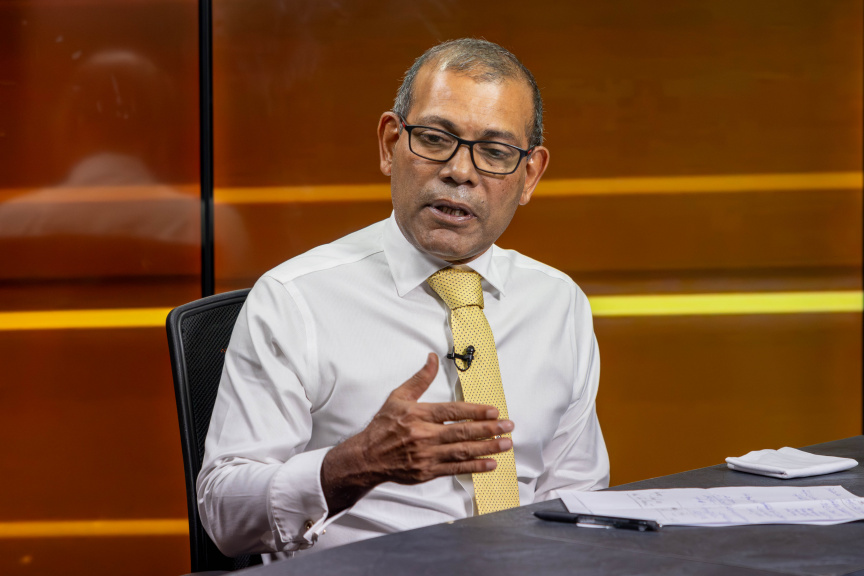
Former president Mohamed Nasheed: Nasheed has warned of allowing corruption of younger generation under guise of homeschooling. (Sun Photo/Mohamed Shaathiu Abdulla)
Main opposition Maldivian Democratic Party (MDP)’s chairperson, former president Mohamed Nasheed, on Wednesday, has criticized a government-backed amendment to the Education Act, warning that permitting homeschooling could lead to the corruption and ruin of the younger generation.
The amendment, sponsored by ruling People’s National Congress (PNC)’s Huraa MP Dr. Anara Naeem, seeks to allow homeschooling for students who are unable to attend school.
As the bill remains under debate in the Parliament, Nasheed voiced his opposition in a post on X, stating that more than 4,000 children are already failing to attend school regularly.
"We must not allow the younger generation to be misled and ruined in the name of homeschooling in the Maldives," Nasheed wrote.
According to data released by the Maldives Bureau of Statistics last year, based on the 2022 census, 91 percent of school-aged children were enrolled in education. However, Education Minister Dr. Ismail Shafeeu had previously stated that only 229 children were out of school. In July, the Minister warned that the Ministry would take action against parents who keep their children out of school without a valid reason.
The current Education Act makes education compulsory for all children aged between four and 16, requiring parents to enroll them in formal education from preschool through secondary school. Although the Act allows the Minister to grant exemptions to children whose circumstances prevent them from attending school, the proposed amendment seeks to formally exempt children with certain disabilities from compulsory school attendance if they are enrolled in homeschooling programs.
Anara’s amendment also stipulates that parents remain responsible for ensuring their children receive an education suited to their needs, even when a disability exempts them from attending formal school. The bill further requires clear criteria to be established under the Education Act to determine the degree of disability that would qualify a child for exemption from compulsory school attendance.