


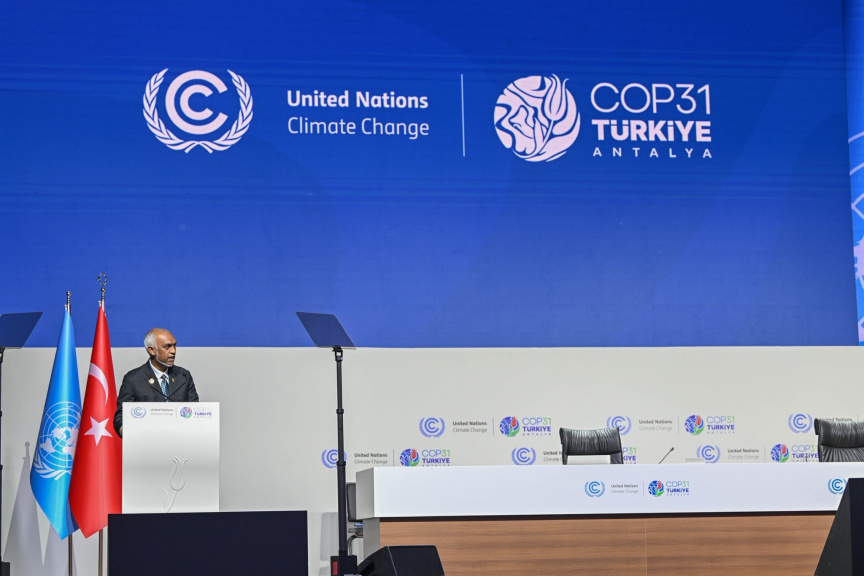
President Dr Mohamed Muizzu delivers the Maldives' national statement during the segment for Heads of State and Government at COP31, November 11, 2026. (Photo/President's Office)
Resilience should not come at the cost of unsustainable debt, and international financial institutions and credit rating agencies must reform the way they evaluate climate investments, President Dr Mohamed Muizzu said while addressing the COP31 climate summit in Anatolia, Turkiye.
Delivering the Maldives' national statement at the summit, the President said resilience should not be viewed as a financial burden, but as an investment in the collective future. He outlined three priorities for addressing climate change: finance, reform and implementation.
Speaking on climate finance, the President said developed countries must honour their commitments to support vulnerable nations. He stressed that climate financing should be new, additional, predictable and grant-based rather than loan-based. He also called for the replenishment of the Green Climate Fund, adequate capitalisation of the Adaptation Fund and sufficient resources for the Loss and Damage Fund.
The President noted that countries such as the Maldives have contributed little to the causes of climate change and should not be expected to borrow their way out of a crisis they did little to create. He also called for reforms to the international financial architecture to better recognise the vulnerabilities of Small Island Developing States (SIDS).
"International financial institutions and credit rating agencies must reassess how climate investments are evaluated. Resilience should be recognised not as a liability, but as an investment in our collective future," the President said.
As the third priority, the President stressed the importance of implementation, saying the Maldives was translating climate ambitions into action through efforts to strengthen food, energy and water security. He also highlighted the recent accreditation of the Maldives' first national direct access entity to the Green Climate Fund, describing it as evidence of the country's readiness to access and deliver climate finance.
His Excellency President Dr @MMuizzu delivers statement at the High-Level Event on Early Warnings for All at COP31. The President stressed the importance of strengthening early warning systems and building resilience to protect lives, livelihoods, and communities from climate-related disasters. #MaldivesAtCOP31 #COP31
— The President's Office (@presidencymv) November 11, 2026
Addressing energy policy, the President said the Maldives remains heavily dependent on imported oil, making the country vulnerable to fluctuations in global oil prices and supply constraints. He described reducing this dependence as a national priority.
The President said significant investment would be required to achieve the government's target of generating 33 percent of the country's electricity from renewable energy sources, including the development of energy generation and storage systems. Given the high cost of building such infrastructure in a small island nation, he called on the international community to provide affordable financing and technological assistance.
He added that the success of the renewable energy transition should not be measured by the size of announced targets, but by the extent to which those commitments are translated into tangible results.