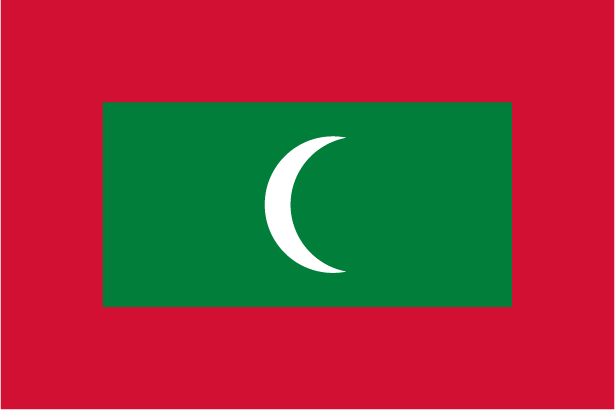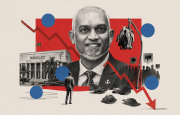


This is something that happened on an island in the Maldives. Collecting palm fronds in the island’s woods for thatching was in full swing. It was every person for themselves—regardless of whether it was midnight, morning, or noon, most people were in the woods trying to gather whatever fronds they could find. Because of this, someone who had previously "ruled" the woods found himself getting fewer fronds. So, what he did was spread rumors around the island that ghosts, locally known as handi, were being seen in various parts of the woods. His goal was to frighten others away from entering the woods, leaving more palm fronds for him to collect.
This is a very common tactic in the Maldivian political arena. Particularly, whichever party is in the opposition at a given time heavily utilizes this scare tactic to gain political popularity and reclaim political office. This is evident both in the history of Maldivian politics and in the current situation.
Gaining Office by Sowing Discord Against Investors
When governments work to attract major foreign investments for the country's economic future and infrastructural development, such projects often become battlegrounds for political rivalry. Maldivian political parties oppose large foreign investments while in the opposition. Although the opposition voices protests against projects brought in by the ruling party as vital for economic revival, those very same parties proceed with similar foreign investments once they gain power. Nevertheless, the impact of this political rivalry is clearly visible in both recent projects and past experiences.
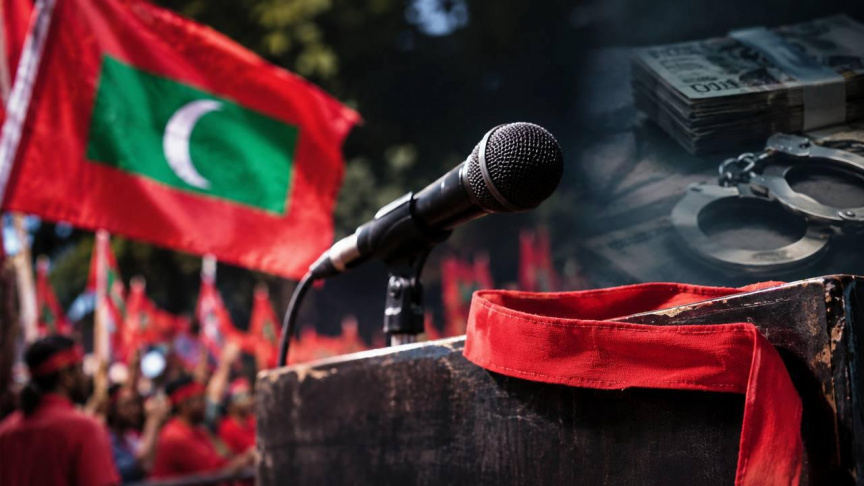
The consequences of such political disagreements can be seen in the past. A prime example is the USD 511 million concession agreement signed on June 28, 2010, during President Mohamed Nasheed’s administration, between the Maldivian government, the 100 percent state-owned Maldives Airports Company Limited (MACL), and the GMR-MAHB consortium to lease Malé International Airport. Similar backlash occurred during the same administration when attempts were made through privatization to move away from a system where the government ran all businesses—a system prone to corruption. Once shares of Dhiraagu and Male’ Water and Sewerage Company (MWSC) were sold, the opposition at the time used these moves as political tools. They took to the streets with bands tied around their heads, chanting "for religion, for the nation." Those were the tactics deployed against the Maldivian Democratic Party (MDP) back then.
During the subsequent administration of President Dr. Mohamed Waheed Hassan Manik, the MDP, now in the opposition, did the exact same thing. First, they called for a boycott of tourism—the main pillar on which the Maldivian economy relies. Later, during President Abdulla Yameen Abdul Gayoom’s administration, the MDP continued in the same vein. They labeled massive, unprecedented development projects carried out in the Maldives by China as "debt traps." They directly protested and halted a major project planned by Saudi Arabia in Faafu Atoll. In this manner, by scaring the public with "ghost stories," the MDP also blocked numerous opportunities that could have benefited the Maldives.

When the MDP later returned to power, the then-opposition Progressive Party of Maldives-People’s National Congress (PPM/PNC) acted in the exact same way. They spread numerous baseless rumors linking things to neighboring India and engaged in many inappropriate acts that belittled India's leaders. They spread falsehoods claiming that Indian soldiers were stationed in the Maldives armed with weapons, portraying every project carried out with Indian assistance as a grave threat. Today, the PNC is in power precisely by having used those scare tactics.
Now, with the PNC in power, both this government and the current opposition are playing the exact same game. As soon as Mohamed Alabbar, who has executed numerous world-class projects, decided to invest in Rasmale', people came out with bands tied around their heads. It is the same old actors performing the exact same drama—the same old routine. Furthermore, because Israelis are currently the people most despised by many Maldivians, critics are linking them to this project. This is a political tactic: manufacturing fear by invoking whatever name is most likely to enrage the public, all in pursuit of massive political popularity.
The proof that these politicians lack sincerity in their scare tactics is that things they deemed acceptable when they held power suddenly become unacceptable today. To the leaders of incumbent administration, India was bad yesterday, but great today. Giving away Faafu Atoll was okay for Yameen, yet carrying out a similar project today is deemed wrong. For the MDP, relinquishing a large portion of the country's maritime territory without consulting the public was fine, and distributing reclaimed and non-reclaimed land in the Malé area as they pleased while in power was also okay. Yet today, Imran Abdulla, who served as home minister during the administration of former President Ibrahim Mohamed Solih, has stepped forward claiming to defend the land. When they distribute it, it is fine; when others do it, it is wrong. This is not how sincere people behave.

All the Losses Fall on the Nation
This is not to say that projects carried out or planned by governments, past and present, are entirely free of flaws. However, whenever a party loses power in the Maldivian political arena, the opposition's resistance to major foreign investments is not solely due to flaws within those projects. Behind it lie calculated schemes to secure their own political futures. Particularly in small island nations like the Maldives, stoking nationalist sentiments by claiming "the country is being sold off" or "sovereignty is under threat" is the easiest weapon used to instill fear in ordinary citizens and bring them out onto the streets against the government. One of the primary motives behind this is to prevent the ruling party from achieving economic success—because if major investments succeed and bring economic prosperity to the country, public support for the ruling party will grow, increasing their chances of winning upcoming elections. Additionally, due to close ties political parties maintain with foreign powers like India and China, they import the rivalries of those nations into domestic politics, running aggressive campaigns against national projects prioritized by the government. At the same time, when governments conceal information from the public and Parliament while signing major agreements, lack transparency, and make sudden amendments to laws, they themselves open the door for the opposition to make such accusations and frighten the public.
The heaviest price for campaigns waged against investments for political gain is paid by the nation's economy. When major projects are dragged into political games and calls are made to cancel agreements with every change of government, foreign investors lose confidence in the Maldives. Consequently, prospective investors hesitate, causing incoming foreign currency and revenue to grind to a halt.

The direct harm of stalled major foreign investments is borne by ordinary citizens. Thousands of potential new job opportunities—especially for youth—are lost, negatively impacting the financial well-being of families. Simultaneously, essential public services and infrastructural development projects are delayed, setting the country's progress back by years.
Manipulating patriotic emotions to sow fear among the public breeds hatred and anger within society, pitting citizens against one another. Moreover, massive campaigns waged against specific countries for political purposes isolate the Maldives on the international stage and severely damage long-standing diplomatic relations. This is not merely damage felt today; it is a profound problem whose bitter consequences future generations will also have to endure.
In short, the nation's economic progress and major foreign investments cannot be sacrificed on the altar of political rivalry. To change this dangerous culture, those in power must operate within a transparent system when executing major projects—disclosing full information to the public and Parliament, leaving no room for doubt or suspicion. Simultaneously, opposition politicians must stop manufacturing "ghost stories" to scare the public for temporary political gain and instead prioritize national interests responsibly. For ordinary citizens, rather than getting swept up in political emotions, discerning the truth and choosing paths that benefit the country's future is the only way to rescue the nation from such political games and establish economic stability. It is time to stop being frightened by the "ghost stories" told by politicians who engaged in theft yesterday when they held power.