

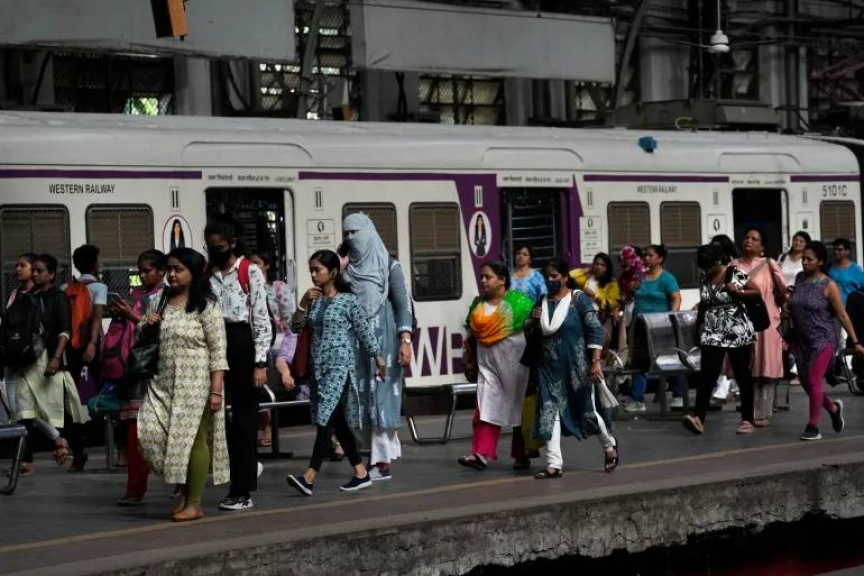
People at a train station in India: Between 2011 and 2023, nearly 500 million people in India moved out of poverty.
The figures are remarkable. Between 2011 and 2023, nearly 500 million people in India moved out of poverty. In its October 2026 Poverty and Equity Brief, the World Bank described this as “one of the fastest poverty declines in the world.” For a country of India's size and complexity, this represents an extraordinary achievement. For smaller neighbouring nations such as the Maldives, it also offers valuable lessons worth examining carefully.
India did not achieve this through a single overarching policy. Rather, it pursued a disciplined focus on the fundamentals: food, healthcare, clean water, housing, energy and financial inclusion. The government made free foodgrains available to more than 800 million people. It introduced health insurance coverage of up to half a million rupees per family annually. It connected millions of rural households to tap water and clean cooking fuel, while bringing previously excluded citizens into the formal banking system through the Jan Dhan programme.
The underlying philosophy was straightforward: ensure that every eligible individual actually receives the benefits to which they are entitled. Not just those with connections, not just those living in urban centres, but everyone.
For the Maldives, the relevance lies not in the scale of India's achievement, but in the principles underpinning it.
The Maldives is a geographically dispersed archipelago where access to public services has historically been uneven. A child growing up on a small island in the south does not necessarily enjoy the same access to quality healthcare, education or economic opportunities as one growing up in Malé. Ensuring equitable access to services for every citizen across the country's 200 inhabited islands remains a significant and persistent challenge.
India's experience demonstrates that targeted, delivery-oriented social programmes can help bridge these gaps when implemented consistently and effectively. The principle of saturation — ensuring that no eligible individual is left out — is one that the Maldives can and should apply to its own development programmes, whether in social housing, healthcare coverage, educational support or business development assistance.
India's emphasis on women's economic participation also offers a particularly relevant lesson. The World Bank noted that much of India's employment growth between 2017 and 2023 was driven by rural women entering paid employment. In the Maldives, women's economic participation, particularly outside the capital, remains an area of considerable untapped potential. Initiatives that expand women's access to finance, skills development and markets can make a meaningful difference to household incomes and the wider wellbeing of communities.
The Maldives has made genuine progress in social development. However, India's experience of lifting nearly half a billion people out of poverty over just over a decade serves as an important reminder: progress accelerates when governments remain firmly committed not only to policy formulation but also to effective implementation. Equally important is the recognition that no community is too remote, and no population too small, to merit attention and investment.