



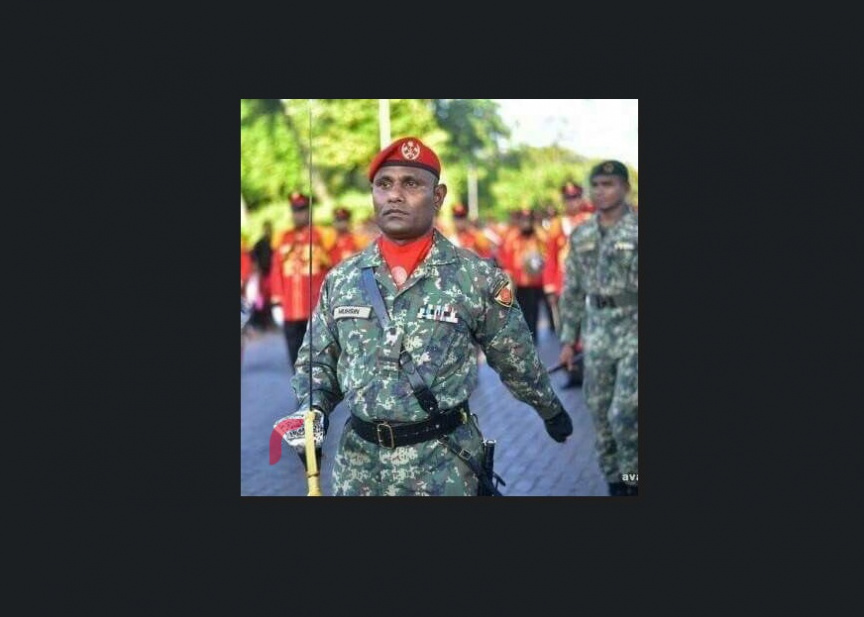
Former MNDF officer Abdul Muhsin Mohamed, demoted and later dismissed from military service for violating the MNDF code of conduct and ethics, May 30, 2018. (Photo/Archive MV)
The Supreme Court has ruled that disciplinary measures taken against former MNDF officer Abdul Muhsin Mohamed, who was demoted and later dismissed from military service for violating the force's code of conduct and ethics, were lawful.
The case stems from disciplinary action taken against Abdul Muhsin Mohamed, who served as Deputy Commander of the MNDF Southern Area. He was demoted from the rank of major to captain and subsequently dismissed in 2018 over allegations that he had used disrespectful and inappropriate language when dealing with a superior officer.
After his dismissal, Abdul Muhsin challenged the decision at the Civil Court, arguing that the action had been unlawful. However, the Civil Court ruled that the disciplinary measures were in line with the Maldives National Defence Force Act and relevant military regulations. The High Court later upheld that ruling.
Abdul Muhsin subsequently appealed to the Supreme Court, seeking to overturn the High Court's judgment. However, the three-member bench unanimously found that there was no legal basis to disturb the lower court's decision and upheld the disciplinary action taken against him.

In its judgment, the Supreme Court addressed several key arguments raised in the appeal. The court noted that allegations relating to unlawful confinement during the disciplinary process had not been included in the original lawsuit filed before the lower court and that no remedy had been sought regarding the claim. As such, the issue could not form the basis for relief at the appeal stage.
The court also held that the MNDF had the authority to demote and dismiss Abdul Muhsin under the regulations governing administrative punishments for offences committed by service members. The judgment noted that he had admitted to the conduct that formed the basis of the disciplinary action.
Another significant aspect of the ruling concerned the publication of military regulations. Referring to Article 61 of the Constitution, the Supreme Court held that regulations intended exclusively for a specific group, such as members of the armed forces, do not require publication in the government gazette in the same manner as regulations that apply to the general public.
The case was heard by a Supreme Court bench comprising Honorable Justices Dr. Mohamed Ibrahim, Hussain Shaheed and Mohamed Saleem.