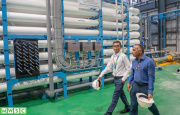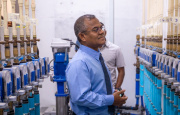



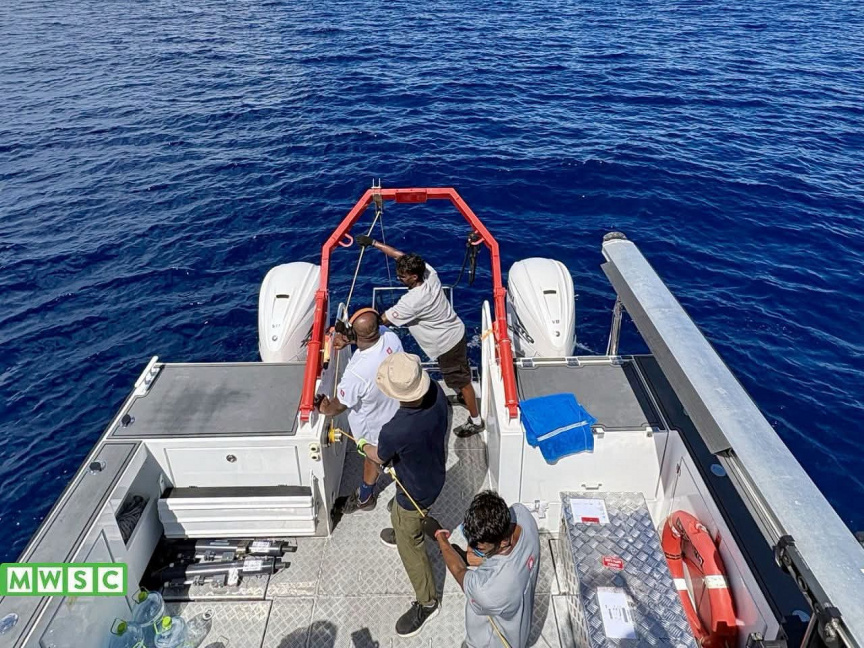
MWSC launches practical study for underwater desalination system in Male' region, October 15, 2026. (Photo/MWSC)
The Male' Water and Sewerage Company (MWSC) has begun practical studies to establish an underwater water-generation system in the Male' region, the first project of its kind in Maldives.
The initiative is part of President Dr Mohamed Muizzu’s vision to transform Maldives into a developed nation by 2040, with modern, sustainable infrastructure at the core of that agenda.
According to preliminary assessments, the most suitable location for the subsea plant has been identified as the outer sea towards the Giraavaru lagoon. MWSC is currently conducting on-site practical studies and detailed water analysis to determine whether the project can be successfully implemented in Maldivian waters.
Norwegian company Flocean has expressed interest in developing the system in Maldives. Based on the results of the feasibility study, MWSC will evaluate whether the technology is technically and commercially viable for the country.
Flocean is a subsea-technology company that emerged in 2024 as a spin-off from FSubsea, a fifth-generation engineering firm with more than a century of subsea processing expertise. The company has gained global attention for pioneering deep-ocean desalination, using modular reverse-osmosis pods installed 400–600 meters below sea level.
WORLD FIRST: A Norwegian startup Flocean is set to launch world’s first underwater desalination plant in 2026. Unlike land based plants, Flocean One will operate 300–600 meters below the ocean surface, using natural hydrostatic pressure to push seawater through reverse osmosis membranes, reducing reliance on energy intensive pumps. This approach is expected to cut energy use and carbon emissions by 30–50% compared to conventional desalination systems. The plant will initially produce around 1,000 m³ of freshwater per day, with a modular design that can scale up to 50,000 m³ per day to support cities, agriculture, and industry. Because the system is underwater, it requires ~95% less coastal land and disperses brine at depth, reducing environmental impact on shorelines. As global freshwater demand rises, this project shows how moving infrastructure offshore and letting physics do the work could redefine how the world produces drinking water.
— SciTech Era (@SciTechera) January 3, 2026
By harnessing natural hydrostatic pressure at depth, Flocean’s systems cut energy use by 30 - 50 percent, eliminate chemical pre-treatment, avoid harmful brine discharge, and require 95 percent less land than conventional desalination plants. Their technology has been featured in Scientific American, Wall Street Journal, and TIME’s “Best Inventions,” and the company is currently scaling commercial deployments worldwide, including its flagship Flocean One plant scheduled for 2026.
If successful, the project would significantly advance MWSC’s goal of providing productive, sustainable and environmentally friendly water infrastructure nationwide.
As part of the ongoing feasibility work, Flocean’s technical team collected water samples from a depth of 500 meters. Initial laboratory analysis shows that deep-sea water in Maldives is unusually clean, making it one of the highest-quality natural sources suitable for desalination feed water.
A technical team from Flocean visited Maldives this week to carry out sampling as part of the subsea desalination feasibility study. Water samples were taken from 500 m below sea level, the clearest sea water we have ever seen. This enables us to carry out extensive laboratory testing to ensure the water meets the quality standards required for feed water. Thank you Water Solutions for making this possible. https://t.co/Axm2jhP6ON
— Male' Water and Sewerage Company Pvt. Ltd. (@MWSC_Official) October 15, 2026
Flocean’s system uses a reverse osmosis process powered by natural hydrostatic pressure, reducing electricity consumption by 40 - 50 percent. The technology also minimizes chemical usage and environmental impacts.
On August 18, 2024, an external company was awarded the contract to conduct the feasibility study for installing the undersea desalination plant.