

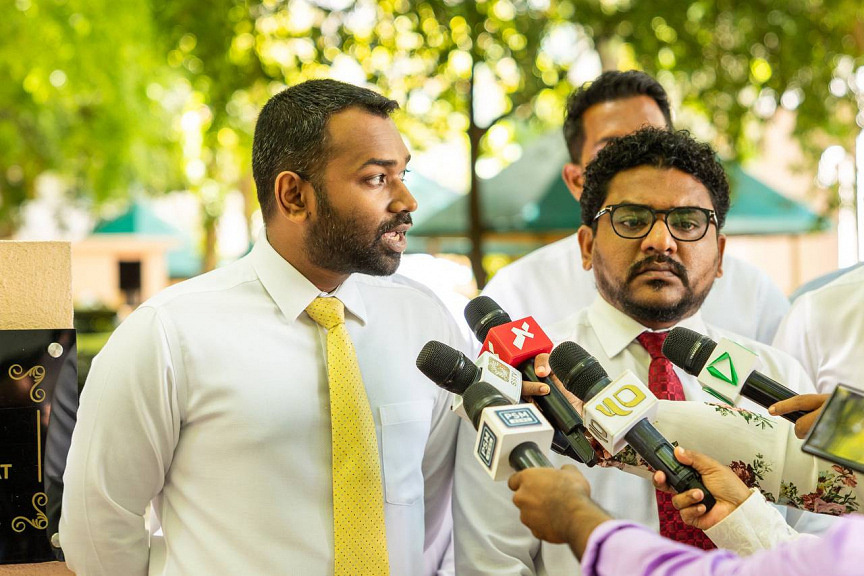
Meekail and Mauroof: MDP Parliamentary Group gives a press conference outside the parliamentary building. (Photo/People's Majlis)
The government has proposed amendments to the Education Act relating to homeschooling, which several members of the main opposition MDP said on Monday, would limit opportunities for children with special needs by reducing their access to mainstream schooling.
Members argued that the changes appear driven by the state’s reluctance to bear the cost of educating children who require additional support.
The government has proposed amendments to the Education Act, including provisions on homeschooling. Debating the bill moved by Dr Anaara Naeem, Kendhoo MDP MP Mauroof Zakir said one of the biggest challenges facing the education sector is the severe budget constraint. He noted that schools frequently call MPs and companies to sponsor basic activities. “Whether it is an extra activity, a sports event, a school anniversary or an awards ceremony, schools are dependent on big companies for funding. I don’t know where we are putting our budget,” he said.

With that, Mauroof said there is now a shortage of teachers and resources for children with special needs. He argued that resources have become so limited that the government is “trying to stop the teaching part in taking these children to schools,” adding that the amendment appears aimed at saving money for the president’s discretionary spending.
His remarks reflect broader concerns in the sector: mainstream schools already struggle to provide specialised support, with SEN teachers in short supply and even essential subjects like Arabic left untaught in large schools due to staffing gaps. In classrooms of more than 30 students, teachers cannot provide the intensive attention required by children with severe autism or other complex needs, and the infrastructure previously built to support inclusive education is deteriorating.
Galolhu South MP Meekail Ahmed Naseem said the government’s proposed amendment is not aimed at expanding opportunities for children with special needs. “We need to be clear about the purpose of this bill. We see that the purpose of this bill does not provide more opportunity to children with special needs. There are conditions in this bill which are to be determined by the state. What are such conditions, what are the requirements, determinable under what policy and how?” Meekail asked.

The Education Act currently provides that the Minister has the discretion to grant exemptions, under regulations made pursuant to the Act, to children who are unable to attend school due to their circumstances. The law states that education is compulsory for every child between the ages of four and 16, and requires all children within that age group to attend school from pre-school through secondary level and participate in the education system prescribed for their age.
However, according to the amendment proposed by Anaara, children who are unable to attend, school or receive education under the homeschooling programme due to disability would not be subject to compulsory education, even though the law ordinarily mandates it. Parents would instead be required to teach their children in a manner appropriate to their disabilities.
The amendment also states that criteria should be formulated under the Education Act to determine whether a child is not required to attend school based on the degree of disability.

In 2015, the Maldivian government under President Abdulla Yameen Abdul Gayoom introduced an integrated national curriculum that incorporated infrastructure for students with special educational needs and disabilities within mainstream schools. Although this marked a significant leap toward global standards for the Maldivian education sector, the rollout was rushed due to political instability. Consequently, the curriculum has struggled to firmly take root within the school system.