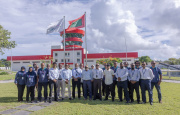



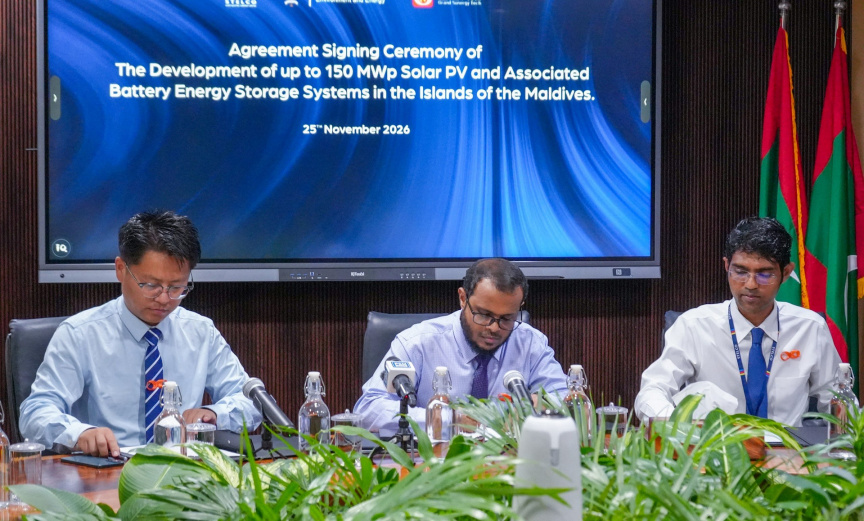
STELCO MD Dr. Ali Azwar (R) and Minister of Climate Change, Environment and Energy Ali Shareef (C) sign a 150-megawatt solar project with China's Goshen Energy Company Ltd, November 25, 2026. (Photo/STELCO)
The Maldives has signed a framework agreement to deploy hybrid systems comprising 150 megawatts of solar photovoltaic (PV) generation, battery energy storage and grid integration across various parts of the country under a power purchase agreement (PPA) model.
The agreement was signed between the Ministry of Climate Change, Environment and Energy, the State Electric Company Limited (STELCO), and China's Goshen Energy Company Limited at a special ceremony held at STELCO Hall.
The agreement was signed by Minister Ali Shareef and Dr Ali Azwar, Managing Director of STELCO, on behalf of the utility company.

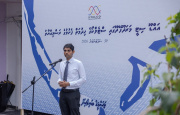
Speaking at the ceremony, Ali Shareef described the initiative as the largest renewable energy project undertaken under President Dr Mohamed Muizzu's policy of generating 33 percent of the Maldives' electricity from renewable sources.
The minister said efforts to achieve the renewable energy target announced by President Muizzu at the COP28 climate summit in the United Arab Emirates in 2023 have already increased the country's renewable energy capacity from 56MW at the start of the administration to 136MW. He added that work is expected to begin on the project next year.

STELCO Managing Director Dr Ali Azwar said the project would bring significant benefits to islands across the Maldives. According to STELCO, the successful deployment of the 150MW hybrid system would help achieve around 60 percent of the government's national target of generating 33 percent of electricity from renewable energy sources.
The project is also expected to deliver substantial economic benefits. Electricity generation accounts for approximately 10 percent of the Maldives' GDP, and the government estimates the initiative will save about MVR 1.2 billion annually through reductions in fuel costs and electricity subsidies.
These savings would allow the government to redirect additional resources towards other key development priorities.
Beyond the economic impact, the project is expected to significantly reduce the country's carbon footprint. The hybrid systems are projected to cut carbon dioxide emissions by approximately 198,283 tonnes per year.