


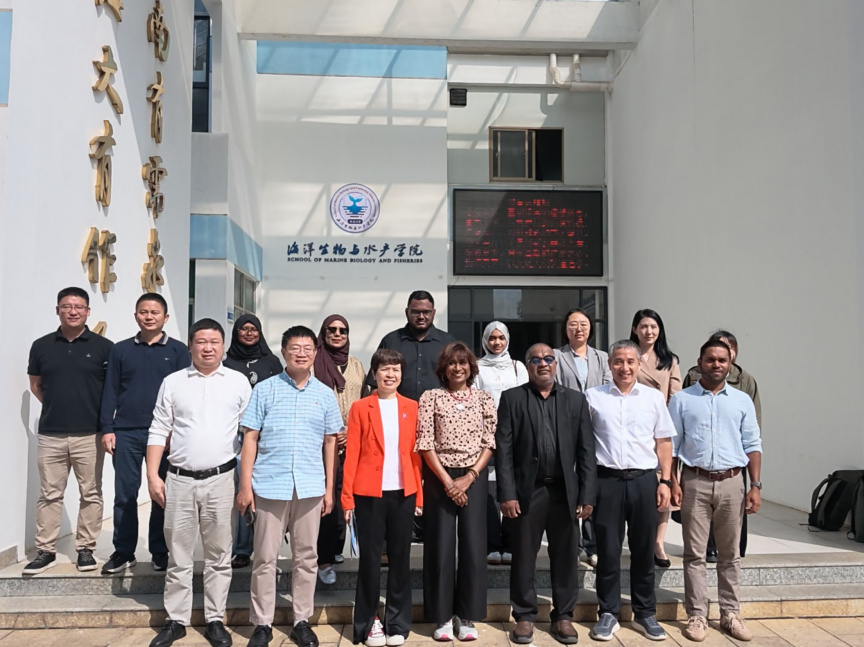
When a delegation from Maldives National University travelled to Hainan, China, it was more than just an academic visit. It marked the beginning of an initiative that could transform how the Maldives approaches marine science research, fisheries education and the training of its next generation of ocean scientists.
The delegation, led by the College of Fisheries and Ocean Sciences, visited Hainan University, one of China's leading institutions in marine biology and fisheries research. What they encountered left a strong impression: world-class research laboratories, active aquaculture facilities, coral reef restoration programmes and an academic model that directly connects students with the fisheries industry. For a country like the Maldives, whose economy and identity are closely tied to the ocean, the relevance of these developments was immediately apparent.
Similar Islands, Similar Challenges
One of the most striking observations made by the Maldivian delegation was the extent of the similarities between Hainan and the Maldives in terms of their natural environments. Both are tropical island destinations, have well-established fisheries and agriculture sectors, and depend heavily on healthy marine ecosystems.
Han Jia, Director of the Division of International Economic Cooperation at the Foreign Affairs Office of Hainan Province, highlighted this connection during the visit. "Hainan Province and Maldives are both located in the tropical areas and we have similar weather, and we have similar industries such as tropical fisheries and agriculture and international tourist destination," she said. "In the future we can explore more cooperation in education, tourism, as well as high-tech."
These environmental similarities go beyond a shared geographical identity. They mean that research conducted at Hainan University, particularly in coral reef restoration, aquaculture and marine ecosystems, is directly relevant to the challenges the Maldives faces in its own waters.

Cutting-Edge Science, Eye-Opening for Students
For the students who accompanied the delegation, the visit provided an opportunity to see what marine science research looks like at a world-class level. Ahmed Riyaz Jauharee, Dean of MNU's College of Fisheries and Ocean Sciences, described the experience as genuinely eye-opening.
"The students had the opportunity to observe cutting-edge research initiatives in Hainan, particularly in aquaculture and coral reef restoration, conducted at their state-of-the-art research centers," he said.
The delegation also visited West Island in Sanya, where marine science education has been integrated into a major tourist destination. This approach was of particular interest to the Maldivian visitors.
Dean Jauharee also acknowledged the gap in research capacity highlighted by the visit, while emphasising the opportunities it presents. "Their scientific advancements currently surpass our own," he acknowledged, "but such visits and the resulting partnerships will undoubtedly pave the way for elevating research standards in the Maldives to new heights."

A Model That Could Transform Maldivian Fisheries Training
Perhaps the most practical outcome of the visit is the education model that Hainan University has proposed introducing in the Maldives. Professor Xie Songguang, Dean of the School of Marine Biology and Fisheries, explained an approach his institution refers to as a "science and technology backyard". Under this model, the university works directly with fisheries companies, placing students and professors alongside industry partners to address practical challenges.
"In this way we solve the technical problem for the fisheries industry. And also in this way we trained our students — and then the students can attach to the industry very well, can serve the industry very well," Professor Xie said.
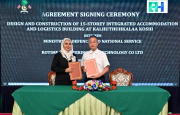
The model has already been implemented in Namibia and Indonesia. Following the signing of a Memorandum of Understanding (MOU) between Hainan University and Maldives National University, plans are now underway to introduce the same approach in the Maldives.
"We will try to transfer this kind of model of student training and the service for the industry to the Maldives," Professor Xie confirmed.

Education as a Bridge Between Nations
Beyond its academic and research outcomes, the visit also carried broader significance. Education diplomacy, which builds people-to-people ties through academic exchanges and institutional partnerships, represents a lasting form of bilateral cooperation. Such relationships can extend beyond political cycles, fostering understanding and connections among professors, researchers and students who carry these ties with them throughout their careers.
The visit to Hainan demonstrated the depth of Maldives-China relations beyond infrastructure and trade. When a Maldivian student stands in a research laboratory in Hainan and witnesses techniques that could one day be applied to protecting a reef back home, the value of that experience extends beyond any formal agreement.

The MoU has been signed, and discussions are underway. What follows — including joint research, student exchanges and the establishment of a science and technology backyard in the Maldives — could shape how the country understands and protects its most valuable natural resource for decades to come.
The ocean connects Hainan and the Maldives. Now, so does science.